

Alarm limits that don’t chatter
High and low level alarms with a deadband.
Turn HighAlarm ON when Level reaches 85%. Keep it ON until Level falls below 80%. Turn LowAlarm ON when Level falls to 15%. Keep it ON until Level rises above 20%. While SignalFault is ON, both alarms are OFF: a failed signal has its own alarm.
 Pro mission
High alarm with a 5% deadband
Test 1 of 4LevelTank level90 %SignalFaultSignal failedOFFHighAlarmHigh alarmONLowAlarmLow alarmOFF- Level
- Applied
- Time
- About 15 min
- Reward
- +250 XP
- Rig
- 3D process tank
- Siemens editors
- SCL, LAD, FBD
- Rockwell editors
- Structured Text, Ladder, FBD
- Course stage
- 23. Alarm limits that don’t chatter
What the tests check
- HighAlarm comes ON at 85% and goes OFF only below 80%.
- LowAlarm comes ON at 15% and goes OFF only above 20%.
- Ripples around a limit don’t flash an alarm. SignalFault turns both alarms OFF.
- Try it Use the buttons below the model and watch the rig respond.
- Test solution Every check runs on your code in one press.
- Replay If one fails, step through it one scan at a time to see why.
Where you’d see this on site
A tank's high-level alarm flashes on and off every few seconds as the surface ripples. The operator starts to ignore it.
Chattering alarms bury the ones that matter. A deadband keeps each alarm steady, and a failed signal must not raise false level alarms.
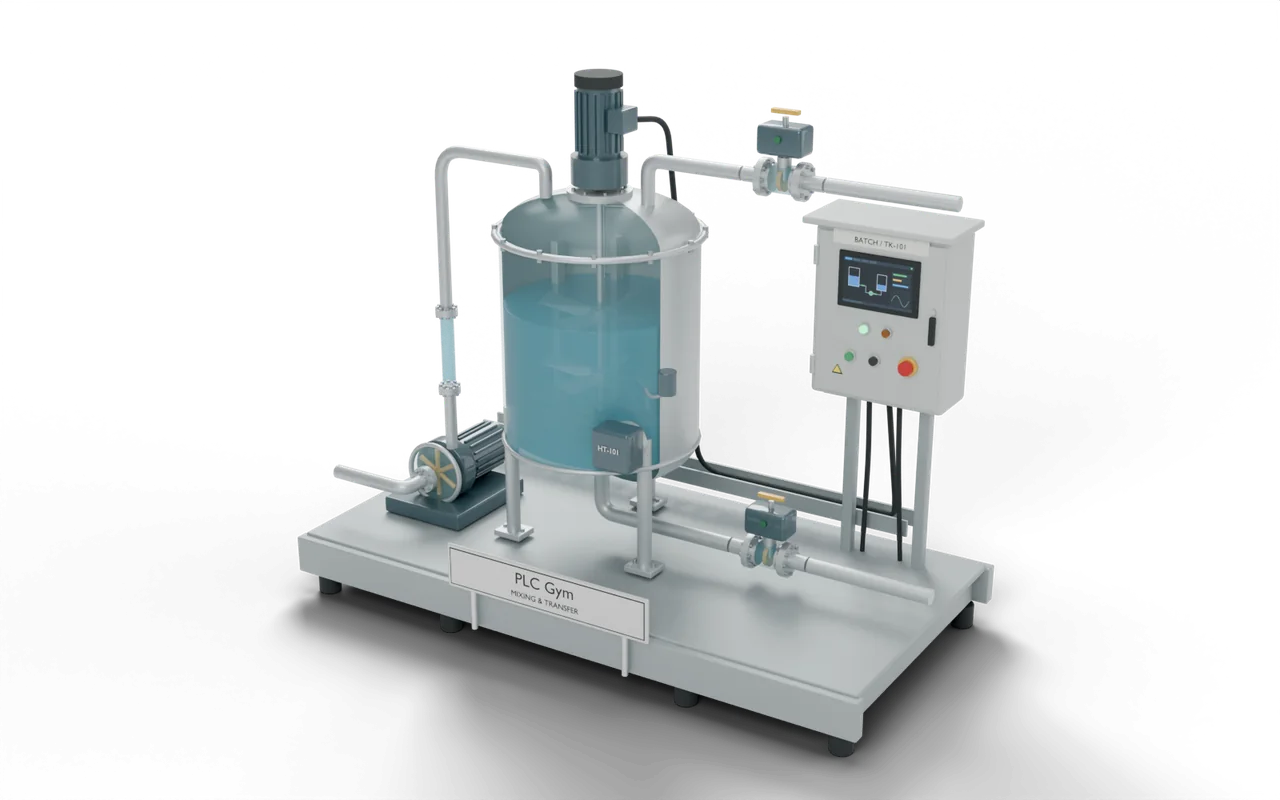
At a drinks factory, valves let measured amounts of water and syrup into a mixing tank. An electric mixer blends them into one batch. An outlet valve then sends the drink to a holding tank. Filling machines bottle it from there.
- Ingredient tanksHold the water and syrup
- Mixing tankFill, mix and measure one batchYou are here
- Holding tankKeeps the finished drink ready
- Bottle fillerPuts the drink into bottles
On a real site: places, parts and safety
- Drinks factory — blending water and syrup
- Paint factory — mixing ingredients into a consistent colour
- Water-treatment works — preparing a measured chemical mixture
- Brewery — heating water for washing equipment
A full tank does not close its own inlet. Water keeps arriving until the valve closes, so an open inlet can flood the room.
A heater that is not covered by liquid can overheat. Real tanks have separate safety devices as well as the PLC programme.
The sizes, timings and cutaways are teaching choices, not a drawing of any one real installation.
Next in the course
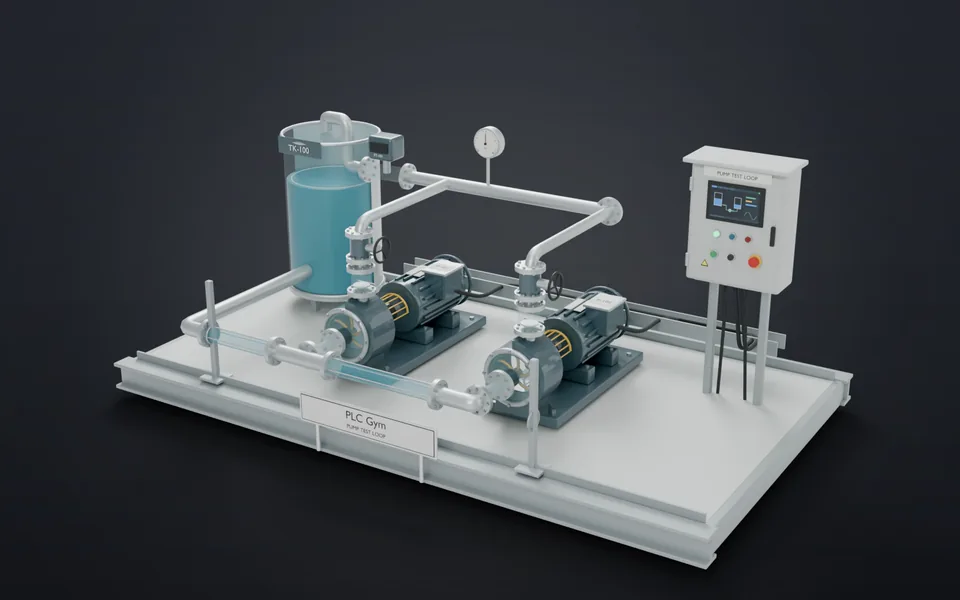 39Run a pump on a driveSend a run command and a speed, then wait for the drive to prove it.Applied · 20 min · +300 XP
- 40Trip, reset, restart on purposeHandle a drive fault without a surprise restart.Advanced · 25 min · +300 XP
- 41It started on its ownAfter a drive reset the pump restarted. Find the memory that survived the trip.Advanced · 15 min · +250 XP
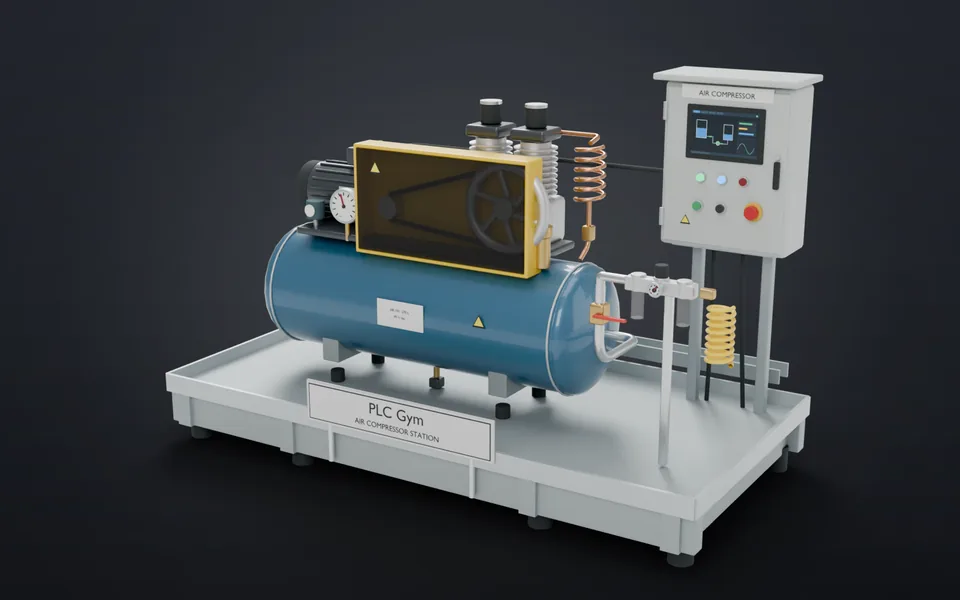 42Keep the workshop in airRun a compressor between two pressures.Applied · 15 min · +250 XP