

PLC technician training: the routes into the job
PLC technician training in the UK: apprenticeships, college courses and self study, what the job involves and the skills employers ask for.

In this guide
PLC technician training isn't one course with one certificate at the end. In the UK, the people who look after PLC controlled machines go by lots of job titles: control and instrumentation technician, maintenance technician, automation technician, controls technician. They get there by a few different routes, and the right one depends on where you're starting from.
This guide lays out those routes, what the job actually involves, and the skills that come up again and again. I've based it on the official apprenticeship standards rather than guesswork, and linked them at the bottom so you can check the detail yourself.
As ever, a quick note on me. I'm not a technician. I'm the founder of PLC Gym, and my background is marketing. So I won't pretend to tell you what a night shift on a packaging line feels like. What I can do is lay out the routes clearly.
What a PLC technician actually does
The clearest description I've found is in England's apprenticeship standard for engineering maintenance technicians. Its control and instrumentation option describes work on programmable logic controllers, flow meters, heat exchangers and safety controls. In other words, the technician keeps the control side of a plant running.
The Level 4 automation and controls standard goes further. It talks about installing and maintaining automation hardware and software across PLCs, HMIs (the touch screens operators use), robots and industrial networks, and about building control panels and using tools such as a multimeter.
Put together, the day to day usually looks something like this.
- Finding out why something has stopped. A sensor has failed, a valve is stuck, a fault has tripped a motor, or a bit of code is doing something nobody expected.
- Checking signals. Is the input really on? Is that level sensor giving a sensible reading? Many instruments send their reading as a 4 to 20 mA signal, and knowing what that means saves a lot of time.
- Reading and changing PLC code. Usually small, careful changes to an existing program rather than writing one from scratch.
- Working safely on electrical equipment. Isolating power, testing it's dead, and following the site's rules.
- Keeping records. Writing down what was changed and why, so the next person isn't left guessing.
Route 1: an apprenticeship
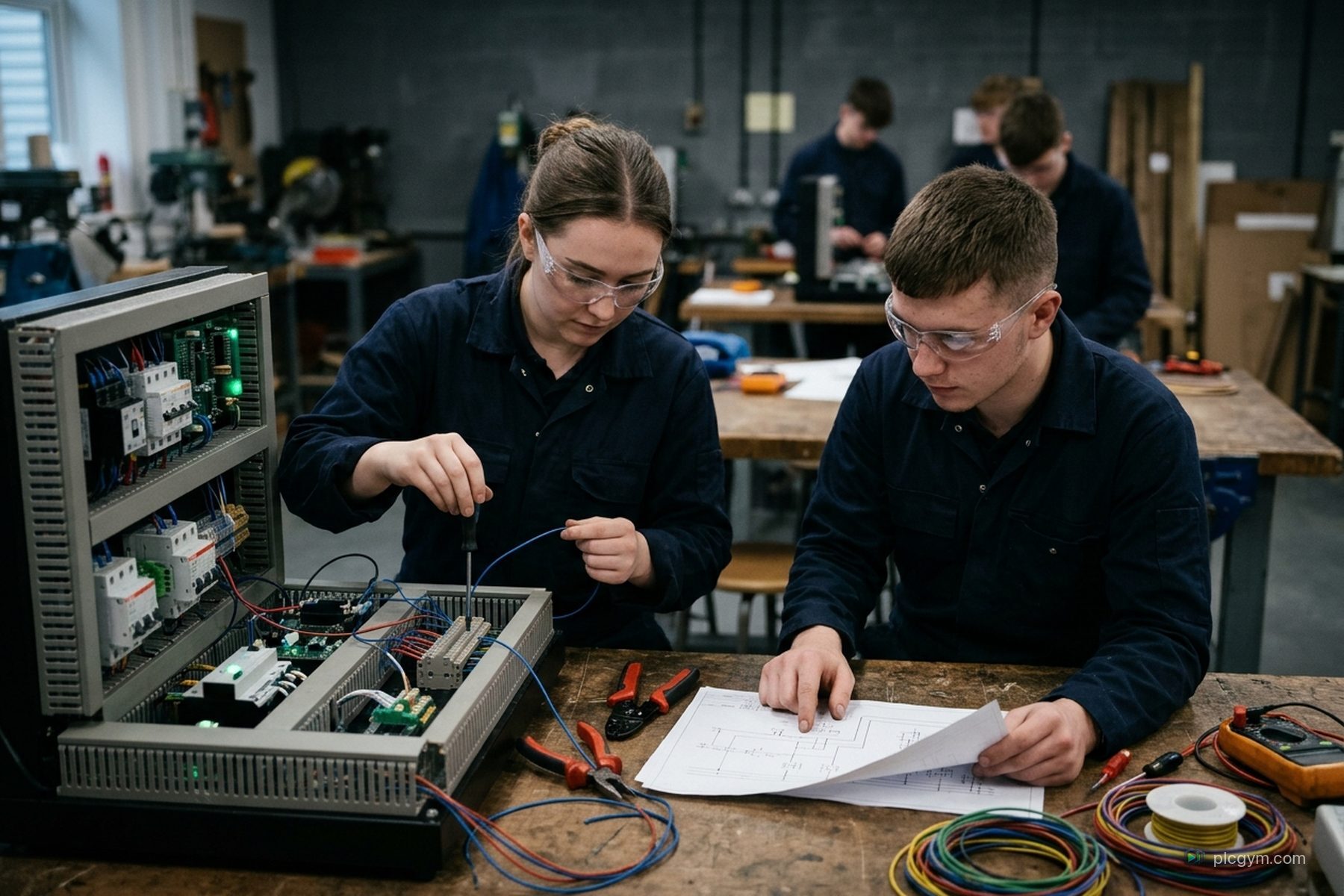
For most people starting out, this is the strongest route. You're employed and paid while you learn, with college study built in, and you finish with a recognised qualification and real experience.
In England, two apprenticeship standards cover this work most directly.
| Standard | Level | Typical length | What it covers |
|---|---|---|---|
| Engineering maintenance technician, single discipline | 3 | 42 months | Maintaining plant and equipment, with options in electrical, control and instrumentation, or mechanical work |
| Automation and controls engineering technician | 4 | 48 months | Installing and maintaining automation systems: PLCs, HMIs, robots and industrial networks |
The Level 4 standard also lines up with professional registration as an Engineering Technician through bodies such as the IET and the IMechE, which is a useful step if you want to progress later. It asks apprentices to complete a Level 4 qualification alongside the job, in an area such as electrical or electronic engineering.
In Scotland, the Modern Apprenticeship in Engineering: Asset Lifecycle and Maintenance runs at SCQF Level 7 and supports roles including instrumentation and control technician.
Apprenticeships are advertised by employers, so the way in is to apply for the jobs themselves. In England, the government's Find an apprenticeship service lists vacancies. In Scotland, Apprenticeships.scot does the same job.
Route 2: college courses
If an apprenticeship isn't possible, college is the next most common way in.
- Electrical or electronic engineering courses, such as an HNC, give you the theory behind circuits, motors and control systems. They can often be studied part time alongside a job.
- Short PLC courses, such as the EAL Level 3 Award in Programmable Logic Controllers, focus on PLC hardware and software and how PLCs are programmed. They suit people who already have an electrical background and want to add PLCs to it.
The catch with college on its own is experience. A qualification shows you understand the ideas, but employers usually also want to see that you've worked on real equipment. Our guide to PLC certification goes into what each kind of qualification actually tells an employer.
Route 3: moving across from another trade
If you're an electrician or a mechanical maintenance fitter, you already have a big head start. You know how to work safely on electrical equipment, read a drawing and find a fault methodically. That's a lot of the job.
What's usually missing is the PLC side: understanding how the program works, reading ladder logic and using the vendor's software to go online and see what the controller is doing. You can build that up with a short course, practice on your own time, and as much exposure as your employer will give you to the controls engineers who visit your site.
The skills that come up again and again
Reading through the standards, a few skills appear in almost every version of the job.
- Electrical fundamentals and safe working. This isn't optional. Isolation and testing must be learned properly, from someone qualified.
- Reading drawings. Electrical schematics and the wiring of control panels.
- Instruments and signals. Sensors, transmitters and what a sensible reading looks like.
- Methodical fault finding. Starting from the symptom and working back, one check at a time, instead of guessing.
- Reading and safely changing PLC code. Especially ladder, and especially safety related logic such as interlocks and permissives.
- Both big brands, at least to read. Job adverts often name Siemens TIA Portal or Rockwell Studio 5000, so being able to move between them helps.
- Explaining and recording what you did. Clear notes and a clear explanation to the next shift.
What you can practise on your own
Some of these skills need a real workshop. But the PLC side, and fault finding in particular, can be practised anywhere.
That's a big part of why we built PLC Gym. Several of our missions start with a machine that's already broken. In one, the Stop button doesn't stop the pump. In another, a pump chatters on and off for no obvious reason. And in The Faulty Filling Station, you have to work out what's wrong with a whole line. Each one makes you investigate first, using the live signals and a scan by scan replay, before you change any code.
If you're new to all of this, our PLC programming course starts from zero and works up to that kind of fault finding. If you already work in maintenance and want something tougher, the expert challenges throw competing faults at you.
A word of honesty
A simulator is a good way to learn the logic and practise fault finding. It isn't a qualification, and it won't teach you to isolate a supply or wire a panel safely. If you want to work on real machines, you'll need proper training and supervised experience, and an apprenticeship is the best way to get both at once.
What practice can do is make you a much stronger candidate. Turning up to an interview able to explain how a seal in works, why a pump might chatter, or how you'd track down a stuck valve says a lot about you. If you're weighing up whether to buy hardware to practise on, our guide to PLC training kits might help, and if you want to start with the logic itself, learning ladder logic is the obvious first step.
Sources
- Engineering maintenance technician, single discipline (ST1426), Skills England
- Automation and controls engineering technician (ST0662), Skills England
- Engineering: Asset Lifecycle and Maintenance, Apprenticeships.scot
- Find an apprenticeship, GOV.UK
- EAL Level 3 Award in Programmable Logic Controllers (PLC), EAL
Practise it
Try it on a working machine
Write real Siemens or Rockwell code in the free online PLC simulator and watch a 3D pump, tank or filling line do exactly what you told it. Nothing to install.
Read next

PLC certification: what it is, and do you need it?
PLC certification explained: what Siemens, Rockwell and UK colleges offer, what employers look for, and when a certificate is worth paying for.
Read the guide
PLC kit for training: do you need hardware to learn?
Thinking of buying a PLC kit for training? What a trainer kit includes, what it teaches well, what it misses, and when a simulator is enough.
Read the guide
Learn ladder logic: rungs, contacts and coils explained
Learn ladder logic from scratch: how rungs, contacts and coils work, how to build a start and stop circuit, and the mistakes beginners make.
Read the guide