

Emergency stop: air out, then back on purpose, PLC programming
Dump the air on an emergency stop, and recover without a surprise.
An emergency stop lets the air out at once and drops every solenoid. Nothing comes back until Reset, and the cylinders come home before a new cycle can start.
No card. Nothing to pay. Nothing to cancel.
Official release: 5 December. Top the leaderboard on the day and win 3 months of Pro, plus 2 weeks of Pro to give a friend. 2nd place wins 4 weeks. 3rd place wins 2 weeks. Rules
- Every Coaching lesson, from zero
- Every mission and lesson, as you level up
- A practical test for every title, with a certificate
- Rewind any test, one scan at a time
- Worked solutions when you're stuck
- The code converter, as much as you like
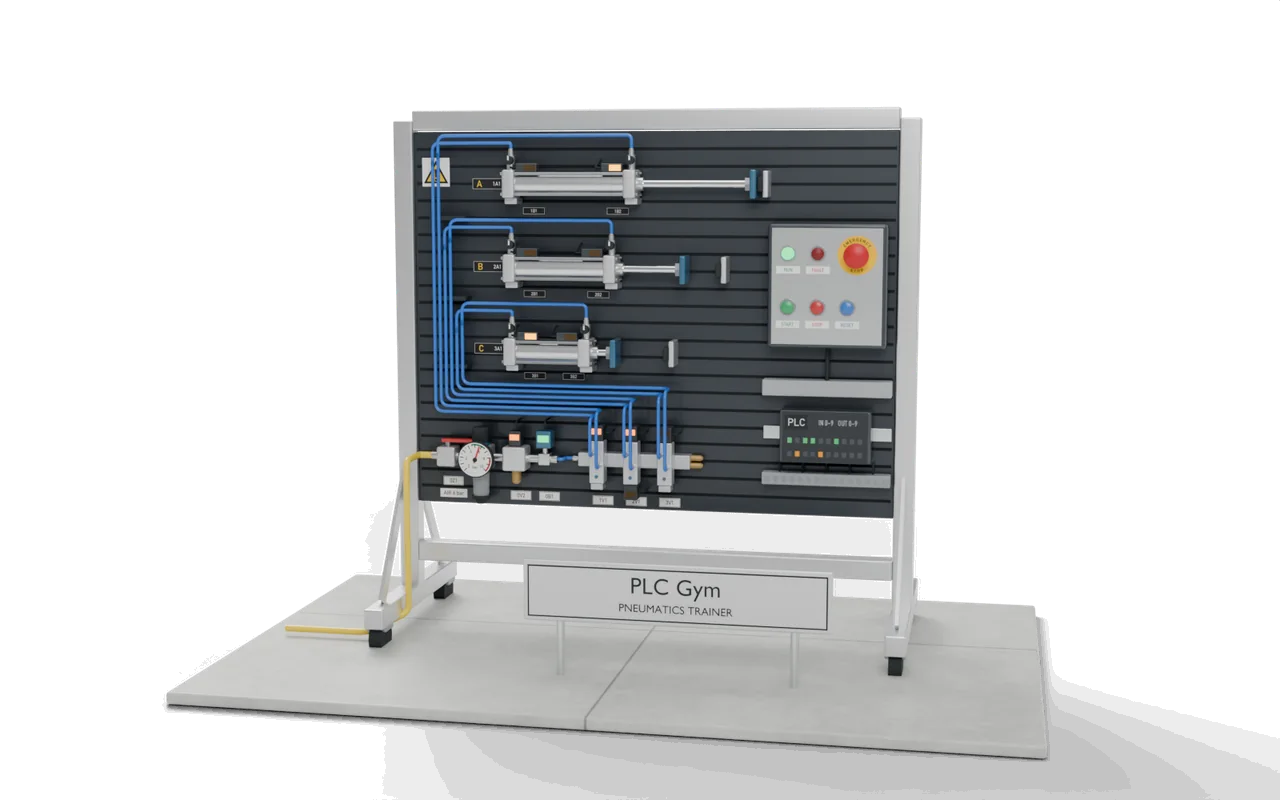 PRO (needs Pro) mission
No air until Reset
Test 1 of 4StartGreen Start pushbuttonOFFResetInputOFFAirOnOutputONExtendAOutputOFF- Level
- Advanced
- Time
- About 40 min
- Reward
- +500 XP
- Rig
- 3D electro-pneumatics trainer
- Siemens editors
- Ladder (LAD), SCL
- Rockwell editors
- Ladder, Structured Text
- Beckhoff editors
- Structured Text
- Stage
- 33. Pneumatics lab: cylinders, valves and reed switches
air out, then back on purpose: what your code must do
The trainer's cylinders carry no load, so its safe state is no air: nothing can move. The emergency stop's contact EStopOK is ON while the button is out. The air is ON only when the trainer is armed. It is not armed when the program starts, and Reset arms it: a fresh press of Reset while EStopOK is ON. Armed, AirOn is ON, and Start runs the A+ B+ B− A− cycle as before (with AirOK, A0 and B0). When EStopOK goes OFF: at once, AirOn OFF, ExtendA, ExtendB and RetractB OFF, RunLamp OFF, the cycle abandoned and the trainer no longer armed. FaultLamp is ON whenever the trainer is not armed. Pulling the button back out changes nothing: only a new press of Reset arms it again. Coming back: A returns on its own, because its spring valve went to 'back'. B's valve remembers, so B would carry on the way it was going as the air returns. From the moment the trainer is armed, hold RetractB ON until B0, unless a cycle is running. The valve needs 2 bar to shift, so it moves as soon as there is enough air. Start is refused until both cylinders are home.
- Armed
- A new press of Reset while EStopOK is ON. AirOn follows it.
- Emergency stop
- At once: air OFF, all solenoids OFF, cycle abandoned, not armed.
- Fault lamp
- ON whenever the trainer is not armed.
- Coming back
- RetractB ON from arming until B0, unless a cycle is running.
- Start
- Needs armed, AirOK, A0 and B0.
- How it's checked
- The checks press the buttons and the emergency stop, then watch the trainer itself: its pressure, its reed switches and its counts of finished strokes.
air out, then back on purpose: inputs and outputs
Your program reads 8 inputs and sets 6 outputs. 2 more inputs drive the simulation or show readings, for you to test with. The names are the same in every maker’s editor.
air out, then back on purpose: what the tests check
- No air and FaultLamp ON until Reset is pressed.
- An emergency stop turns AirOn and every solenoid OFF at once, and abandons the cycle.
- Releasing the emergency stop restores nothing. Only a new press of Reset does.
- After Reset, B comes home without finishing the stroke it was on.
- A new cycle needs Start, with the air up and both cylinders home.
- Try it Use the buttons below the model and watch the rig respond.
- Test solution Every check runs on your code in one press.
- Rewind PRO (needs Pro) If one fails, step back through it one scan at a time to see why.
Stuck on this mission? Ask the members in the Locker Room.
Where you’d see this on site
Machines with air cylinders have a dump valve like this, and on a real machine a safety relay switches it. The PLC follows, so that it restarts nothing when the relay is reset.
When the air returns, a cylinder whose valve remembers 'out' goes out, with nobody having pressed anything. Unexpected movement after a stop is one of the commonest ways people are hurt by pneumatic machines.
Most machines that clamp, push, lift or eject do it with air cylinders. A solenoid valve sends air to one side of the piston and lets it out of the other, and a small switch on the barrel tells the controller when the piston has arrived. Colleges teach it on a board like this one, because the same few parts make up almost every pneumatic machine.
- Air supplyFiltered, set to 6 bar
- ValvesOne 5/2 valve a cylinder
- CylindersOut and back on airYou are here
- Reed switchesProve each stroke
On a real site: places, parts and safety
- Assembly machines that clamp a part, then press or drill it
- Packing lines that push, lift and eject cartons
- College and apprentice training workshops
Compressed air is stored energy. Shut the isolator and let the air out before touching pipework: a hose that comes off under pressure whips.
Letting the air out isn't always the safe state. A cylinder holding a load upright drops when the air goes, so real machines are assessed one cylinder at a time.
The sizes, timings and cutaways are teaching choices, not a drawing of any one real installation.
Next on the road
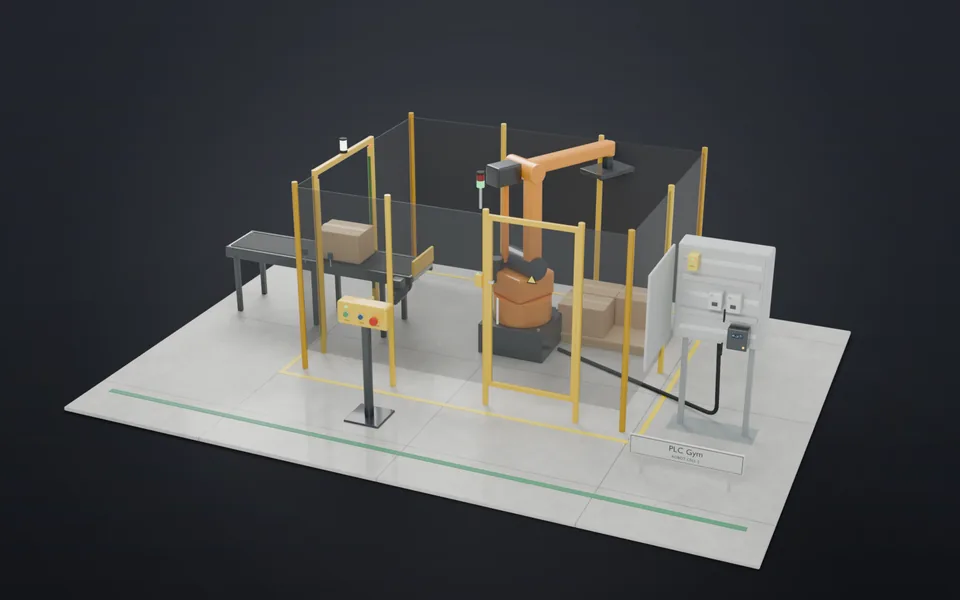 64Two channels must agreeRead the E-stop and the gate on two channels each, and lock the cell out when a pair disagrees.Advanced · 40 min · +550 XP
- 65Prove the contactors let goCheck the contactors' mirror contacts, and refuse a reset while one is welded shut.Advanced · 40 min · +500 XP
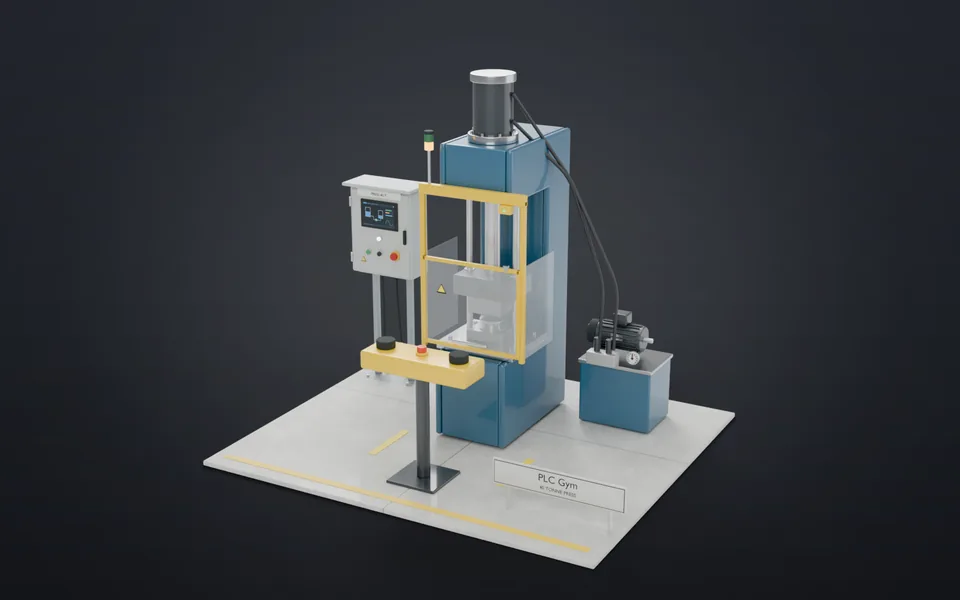 66Both hands, checked twiceAdd checked palm buttons, an emergency stop and a reset to the two-hand press.Advanced · 45 min · +650 XP
- 67Stop dead or slow downMake the E-stop a category 0 stop and the gate a category 1 stop: brake first, then cut the power.Advanced · 40 min · +500 XP